

by Barry Kamil
Over my 36 years at Netivot Shalom, I have engaged in many conversations with fellow congregants and with rabbis, individually and collectively, in listening sessions and at Board meetings. We have discussed the nature of our ritual observances, the meaning of social justice for practicing Jews, and ways to bridge our differences so we can remain true to both our personal values and each other. I’ve had conversations with people whose views are very close to mine and with others that revealed fundamental disagreements.
In a conversation with our last Scholar-in-Residence, Dr. Benjamin Sommer of JTS, about how Jewish communities deal with fundamental differences, he recommended Rabbi Edward Feld’s Book of Revolutions. Rabbi Feld is the Senior Editor of our Lev Shalem Siddur (in which he wrote an inspiring Introduction on the Exodus, Torah and Redemption, which I highly recommend reading) and the Lev Shalem Machzor, and he has been Rabbi-In-Residence at the Jewish Theological Seminary.
Rabbi Feld’s book transported me to a landscape both strange and familiar where our Torah, its history, teachings and values, were composed. Rabbi Feld reveals our Torah as an ongoing creative endeavor encompassing the work of many souls, receiving and understanding divine inspiration over many centuries, including us! For me, the question of what the correct, faithful interpretations are has been replaced by an appreciation for the different strands and interpretations our heritage carries, refracted through our different views, all emerging from the pluralistic soil of our Torah. In a time when our differences can seem divisive, Rabbi Feld’s book offers a hopeful perspective.
I offer this review and summary of Rabbi Feld’s book with the hope that you will appreciate its plunge into the creative cauldron that formed our Torah.
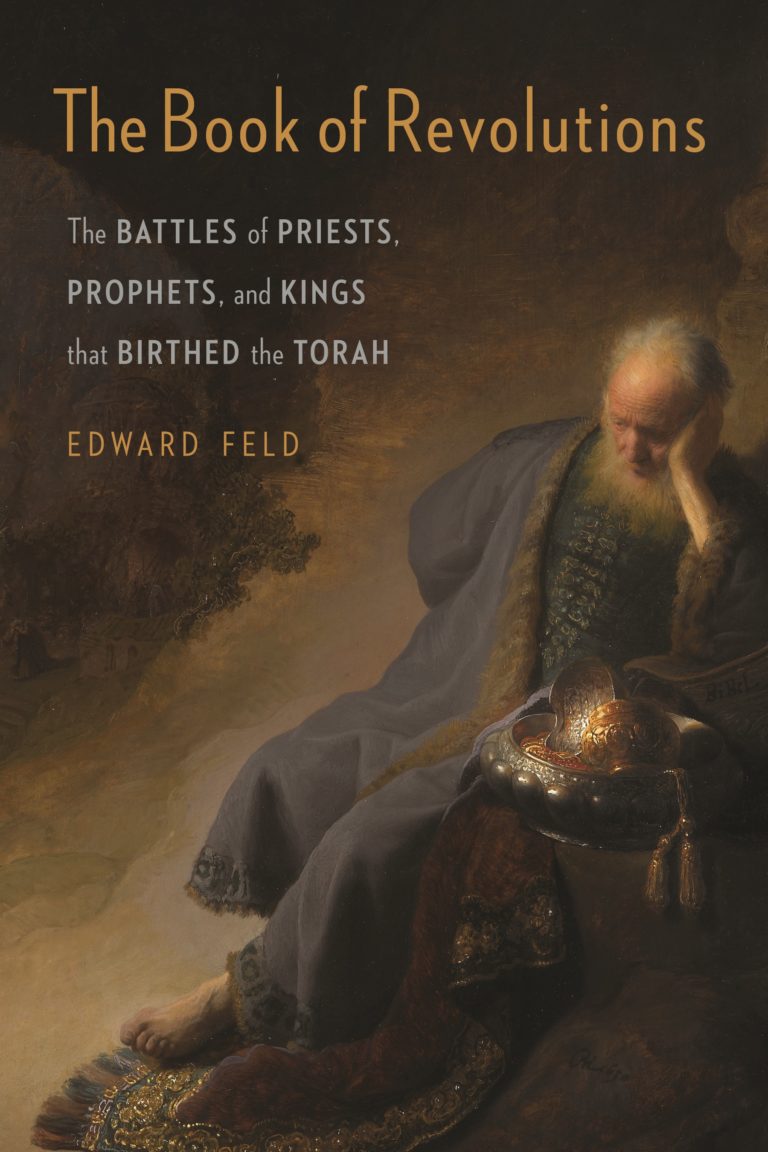
The Book of Revolutions: The Battles of Priests, Prophets and Kings That Birthed the Torah
by Rabbi Edward Feld (Jewish Publication Society, May, 2022)
In this fascinating book, Rabbi Feld shows how the Torah is a collection of diverse viewpoints born from real-life conflicts, rather than a single unified voice. He takes us on a 500-year journey from the early Israelite monarchies to the Babylonian exile and return, when the Torah’s various narratives, halachot and three core ethical codes were compiled. He shows how conflicting viewpoints were woven together and ultimately preserved in our Torah.
In explaining the book’s title, R’ Feld writes:
“The Torah is truly the Book of Revolutions, born from a military coup (the Northern Israelite revolution), the aftermath of an assassination and regency (a Judean revolution), and a quiet but radical revolution effected by outsiders whose ideas proved persuasive (Babylonian exile). Emerging from each of these were three key legal codes—the Covenant Code (Exodus), the Deuteronomic Code (Deuteronomy), and the Holiness Code (Leviticus)—which in turn shaped the Bible, biblical Judaism, and Judaism today.”
With these three core ethical halachic codes as a framework, R’ Feld organizes his chronology of the formation of biblical Judaism into three main sections: “Revolution in Northern Israel,” “Revolution in Judea,” and “Revolution in Babylonia.”
If the word “revolution” seems discordant for an account of the development of early Judaism, the book quickly unburdens us of any illusions of a gradual evolution of Israelite society. In fact, regicide was as common a practice in early Israelite history as it was throughout the British monarchy.
In the first section, “Revolution in Northern Israel,” R’ Feld notes that during the period of the house of King Jehu from the mid-9th to mid-8th century BCE, the prophets Elijah and Elisha advanced the exclusive worship of Adonai (YHVH), criticizing the corruption of justice by the reigning monarchs. In this period, the first biblical law code, the Covenant Code (Exodus 21-22), portrayed the relationship of the people to God as a sacred covenant. R’ Feld explains that chapter 24 of Exodus “is clearly the work of many hands… a compendium of materials from disparate sources… bringing together earlier case law… fusing these laws with the religious understanding that… became the articulated ideology of the Northern Kingdom” (31, 36). He adds, “Undoubtedly the code draws on earlier precedent going back to a tribal past” (39).
The second section, “Revolution in Judea,” set in the mid-8th to early 6th centuries BCE, explores the formulation of our Torah during the political and religious battles between the northern kingdom of Israel and the southern kingdom of Judea. The books of Kings and Chronicles document how successive monarchies vacillated between faithful adherence to monotheism and reversion to polytheistic practices including child sacrifice, what R’ Feld calls “this see-saw battle through the generations” (65). Looming over these developments was the threat posed by the northern Assyrian empire.
Near the end of the Judean kingdom, King Josiah advanced reforms away from lingering polytheistic cult practices, ordering the renovation of the Temple, where a “scroll of God’s teaching,” the “Sefer Hatorah,” was discovered. R’ Feld notes that “The overwhelming majority of biblical scholars agree that the book found in the Temple was the book of Deuteronomy” (93). The ideology of Deuteronomy so closely coincides with King Josiah’s reforms that, according to R’ Feld, “Deuteronomy can easily be seen as offering a historical justification for the reform of Josiah’s day” (94). Deuteronomy expands on the Covenant code adding ethical imperatives including the famous exhortation “Justice, justice shall you pursue” and a call for the protection of workers and the poor (99). Following his institution of the Deuteronomic reforms, King Josiah was killed in battle, Judea was squeezed between the forces of Egypt and Babylonia, and Josiah’s reforms were reversed.
In the third section, “Revolution in Babylonia,” R’ Feld recounts how Judean government officials and communal leaders were singled out for exile, while the largely leaderless farmers were left behind. For the exiled Judeans, who were allowed to remain an intact community within Babylonia, memories of the Deuteronomic reforms were fresh. A group of exiled priests and prophets, including Ezekiel, envisioned a return to the land, a revitalized Temple, and a new just society led by priestly prophets without a monarchy. From their exile in Babylonia, these priests and prophets generated the Holiness Code in the book of Leviticus (Chapter 19, verse 34) which “warns against oppressing the stranger and then offers…the extension of the law of love to ‘the stranger who dwells in your midst’…This idea… should not be too foreign to the people Israel: remember that you were once slaves in Egypt” (181).
R’ Feld notes that it was in exile that the Sabbath achieved a new prominence. “Sitting in Babylon, without a Temple, there were limited ways in which people could feel close to the Divine. The Sabbath provided the means by which the exiled community of Israel could share in a regular, weekly sense of sanctity. Earlier biblical codes give the Sabbath much less prominence and a much different meaning… It is only in the Holiness Code that the Sabbath is given a divine function” (195-196). R’ Feld adds that the Holiness Code insisted on “…the need for personal transformation and its dream of a utopian society… the sensibility of the Holiness Code permeates the entire Pentateuch and, in turn, later Judaism’s self-understanding” (208-209).
From there, R’ Feld traces the influence of the ethical halachic codes on contemporary Jewish thought. Martin Buber’s “unfolding of the meaning of ‘Love your neighbor as yourself’… When the ‘I’ and ‘You’… come to understand each other…the Divine becomes present for them” (216). “The theologian Abraham Joshua Heschel captures the spirit of the Holiness Code. He talks of…worldly acts as furthering justice, which, similarly manifests the Divine presence” (216).
In the final section of the book, R’ Feld recounts the return to the land of Israel of the Babylonian exiles, led by Nehemiah and Ezra after 70 years of displacement, and the resistance of the Israelites who had remained in place to the “new strictness in the peoples’ observance of the seventh day… experiencing it as a new and foreign ritual demand” (223). “The Pentateuch as a fully edited text is the work of Babylonian Jewry. In the Land of Israel, it is only when we meet the figures of Ezra and Nehemiah, exiles who come to Jerusalem from Babylonia, that we have a call to return to the norms of the Torah as we know them” (227).
In a kind of epilogue, entitled “Final Thoughts,” R’ Feld reflects on what these various strands of our Torah mean for us today as we continue the tradition of reinterpreting and renewing our understanding of the Torah. He writes, “…the plurality of opinions encompassed in the Torah… must be read with the same freedom… with the delight in the kind of ambiguities that give texts deeper meaning… The decision to be inclusive, to incorporate vying ideologies in a single work… ensured that though there was a broad direction…there was not a single, right pathway… even though many would try to formulate a single-minded summary of the Torah” (246). For us today, the lack of consensus in the Torah “compels us to act as an ‘interpretive community’ responsible for finding our own understandings and practices, and by implication, demanding the tolerance necessary to accept and respect differences, while continuing ‘to love your neighbor as yourself’” (249). As R’ Feld concludes, “The full embodiment of the Torah is always just out of reach. Always, there is a new midrash, a new line of interpretation we need to write for our own time…The life of Torah is an ongoing series of revolutions, an ongoing series of revelations” (254).
I find the idea that we must continue the ongoing process of interpreting our inherited sacred texts exciting and invigorating. This book was revelatory for me in many ways. I hope this brief review inspires you to read it and/or to reach out to me ([email protected]) to discuss these ideas further.